
Island mode & black start
Grid down. Power on.
When the grid fails, COR.stor switches to its own supply automatically. Lighting, refrigeration, heating pumps and internet can keep running.
- typically 20 ms switchover
- 70 kWh usable
- island mode and black start
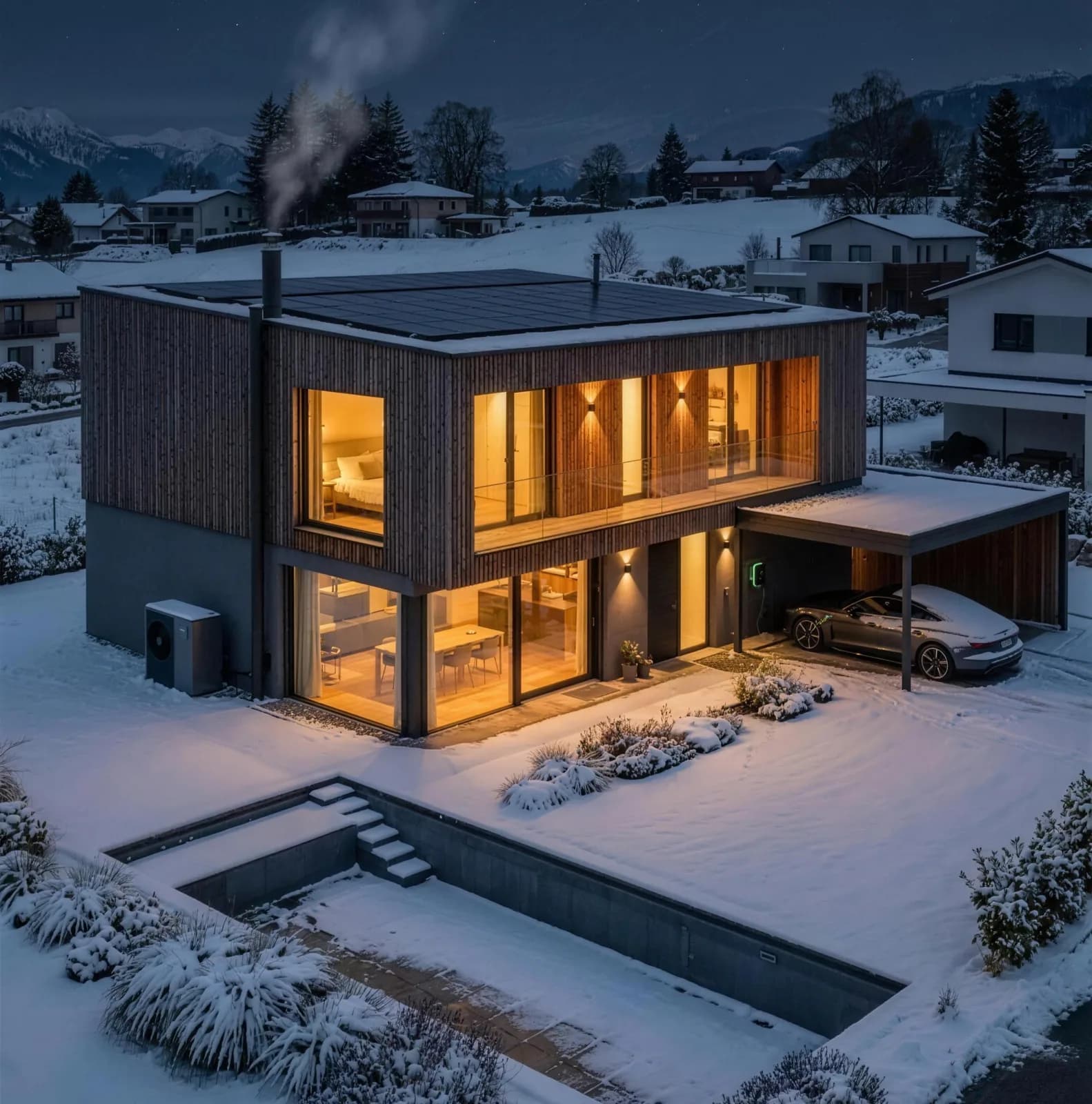
The building stays supplied.
In island mode the system keeps supplying the building — from the storage unit for as long as it holds energy and, in COR.set during the heating season, also from the heat and power plant, which recharges the storage unit as it heats.
The switchover happens automatically, without you lifting a finger. The whole building is supplied, up to 15 or 30 kVA — not just a single backup socket.
The storage unit bridges the outage. The grid stays connected.
Grid failure
The grid goes down.
COR.stor switches to island mode — typically within 20 ms.
Island mode
The storage unit takes over.
The building keeps running from the storage unit.
In COR.set · heating season
The heat and power plant recharges.
As long as there is heating to do, COR.gen feeds into the island grid set up by the storage unit — and recharges the storage as it runs.
Restart even without the grid.
Black-start capable means the system can re-establish its own supply even when the public grid is not available.
In COR.set, the heat and power plant also feeds into this supply for as long as it is heating.
Typically 20 milliseconds switchover time.
That is how quickly COR.stor takes over when the grid fails. Most devices keep running without a noticeable dropout.
Data sheet value: typically 20 ms, maximum 80 ms, depending on the type of fault.
87% expect one day at most. The Civil Protection Association advises ten to fourteen.
In EY’s Blackout Readiness Check (January 2026, 1,000 respondents), 87 per cent of Austrians assume the power will be back within 24 hours; more than half expect no more than five hours. The Austrian Civil Protection Association recommends stocking up for ten to fourteen days. One household in five has made no preparations at all.
On 28 April 2025, 55 million people on the Iberian Peninsula lost power. It took more than twelve hours to bring the grid back — triggered by a local fault that cascaded.
COR.stor bridges the gap — switchover typically within 20 ms — and keeps the whole property running within 15 or 30 kVA: light, refrigeration, heating pumps, internet. No generator set or diesel needed.
Sources: EY Blackout Readiness Check, 13 Jan 2026 · ENTSO-E final report on the Iberian Peninsula outage of 28 Apr 2025 · Austrian Civil Protection Association, Blackout guide
How long does your storage unit last?
Choose what should keep running during an outage. The calculation runs against 70 kWh of usable capacity.
Your home runs for
13.9 dayswith a fully charged battery
4.9 kWh/day
Civil Protection Association recommends: 10–14 days
Recommendation met.
Guide values for an average household, not a guarantee. A system base load of 0.5 kWh per day is included. Yield from a PV system is not counted — with sunshine the storage unit lasts longer. Actual consumption depends on appliances, building and use.